Super Ideal Cut Diamonds vs Triple Excellent: The Truth
If you're spending five figures on a diamond, you want to know it'll actually sparkle. Not just look good on paper with a GIA certificate, but...
Armadale (03) 7019 8100
Brighton (03) 9593 2197
Canterbury (03) 9830 5600

Make an Appointment
Brighton (03) 9593 2197 | Canterbury (03) 9830 5600

A client walked into our Brighton showroom this year to compare two stones: a 1.8-carat natural solitaire she’d bought eleven years earlier, and a lab-grown pendant she’d bought her daughter three years before that. She wanted an honest valuation on both before deciding what to trade in.
The natural stone had held its value. The lab-grown one hadn’t.
That difference is why so many of our Melbourne clients ask us the same thing: are diamonds a good investment, or simply beautiful things we tell ourselves will hold their value?
At Holloway Diamonds, we’d rather give you a straight answer — because when you buy well, source natural stones and understand how resale works, a diamond can behave like a resilient store of value.
There’s no single yes or no answer, because diamonds don’t behave like financial assets. They generate no income, they’re not traded on an open exchange, and their price is set by a fairly opaque combination of rarity, quality and dealer sentiment.
What we can say, from five decades of sourcing, cutting and reselling diamonds through our Melbourne showrooms, is this: quality natural diamonds have historically been far more resistant to value erosion than the diamond market as a whole.
Roughly how far rough natural diamond prices fell between their 2022 peak and late 2024 — largely dragged down by lab-grown competition.
That’s according to data compiled by diamond market analyst Paul Zimnisky. But the decline hasn’t hit every stone equally. Larger, better-cut, well-certified natural diamonds have consistently proven more resilient than commercial-grade goods.
That’s not what diamonds are for.
Lab-grown diamond wholesale prices have been in freefall for several years as production scales up. According to wholesale data published by Edahn Golan Diamond Research, they fell 26% year-on-year in 2025 alone, with three-carat stones down even further — on top of steep declines in prior years.
year-on-year, in one year alone
per carat, per Garry Holloway’s price comparisons
Edahn Golan has relied on Garry Holloway’s lab-grown price comparisons over the years, which show wholesale prices have fallen to well under $100 per carat. Manufacturing efficiency keeps improving and supply keeps growing faster than demand — wonderful news if you want a bigger stone for your money today, and a serious problem if you’re hoping that stone holds its value tomorrow.
Natural diamonds don’t have that problem, because nobody is manufacturing more of them.
Supply
Finite by nature
Keeps expanding
Price trend
Quality stones more resilient
Falling year on year
Secondary market
Dealers, auction houses and jewellers who want to buy them back
No established resale infrastructure yet
Trade-up
Accepted on generous terms
Generally not on the same terms
Holloway Diamonds has only ever sold natural diamonds and gemstones since Garry Holloway opened his first store.
It’s the reason our trade-up terms can be as generous as they are. We’re not asking you to trust a market that didn’t exist ten years ago.
Resale value comes down to a much narrower set of factors than most people assume — and almost none of them are about brand names.
A diamond’s fire and brilliance come almost entirely from how precisely it’s cut. It’s why Garry Holloway invented the Ideal-Scope in 1986 and the Holloway Cut Adviser (HCA) in 2000 — because a GIA “Excellent” cut grade still leaves enormous variation in how much light a diamond leaks.
GIA “Excellent” diamonds we reject, because they still fail our own cut testing.
A diamond that never leaks light retains far more of its resale value than one that simply carries a good certificate.
GIA-certified stones are the benchmark the global trade relies on when reselling or trading in a diamond. An uncertified stone, or one graded by a less rigorous lab, will always be discounted at resale — regardless of how it looks in the setting.
A D–F colour, eye-clean natural diamond of 1 carat or above will always find a buyer more easily than a larger, lower-grade stone. Rarity, not size alone, is what holds diamond resale value over time. Desirability is what counts.
A diamond bought at a heavy retail markup, or purely for its branding, starts its resale journey from a lower baseline. One bought from a jeweller who sources close to the cutting house and backs it with a trade-up program starts from a stronger position.
Diamonds regularly get lumped in with gold, art and collectibles as an alternative asset class, and the comparison is useful up to a point.
Transparent, near-instant pricing you can check on your phone. Sold at a fixed spot price — more liquid than diamonds, but far less wearable.
A handful of blue-chip works produce outsized headline returns. Harder to store, insure and transport, with a much higher entry point.
Portable, easy to insure and accessible — and you can wear one to work on a Tuesday, which is more than you can say for a Basquiat.
Every diamond is graded on its own combination of the 4Cs, so two stones of the same carat weight can be worth wildly different amounts. Combine the 4Cs and there are roughly one hundred thousand diamond categories and prices. That makes diamonds more portable and wearable than gold bullion, but less liquid.
Treat a beautifully cut natural diamond as a long-term, tangible asset that happens to sparkle.
If you’re holding a natural diamond you bought years ago and wondering what it’s worth today, resale to a private buyer or auction house is rarely the best route.
Most established jewellers, Holloway Diamonds included, will apply the assessed value of your existing natural diamond directly toward a new piece. Our program to trade in diamond rings for upgrades works like this:
Any natural diamond of 0.25 carats or larger
Regardless of where it was originally purchased
Our gemmologists’ assessed value, matched by an equal contribution
This only works, of course, if the diamond you’re trading is natural. Lab-grown, clarity-enhanced or colour-treated stones generally can’t be traded up on the same terms anywhere in the market, because there’s no established resale infrastructure for them yet.
If your existing setting has sentimental value but the stone needs upgrading, consider engagement ring remodelling in Melbourne rather than starting from scratch. We rework heirloom gold and existing gemstones into a design that suits your current lifestyle, while keeping the piece that matters to you intact.
A well-chosen diamond can hold its value for decades, but only if it’s looked after and properly documented. A few things to protect your position:
If you’re ever burgled or the piece is lost, you’ll need your certification and valuation to make an insurance claim or prove provenance at resale. You’ll also need your certificate to trade up, as it reduces the cost of recertification.
Insure at current replacement value, not purchase price. Ask your jeweller for an updated valuation every few years, particularly before any trade-up conversation.
A loose claw or worn prong risks losing the stone entirely — a bigger threat to value than any market movement.
A GIA report attached to your specific stone — not a generic certificate — is one of the biggest factors in how quickly and confidently a jeweller can assess it for trade-up or resale.
Whether you’re considering a trade-up, a remodel, or simply want an honest valuation, our gemmologists can assess your natural diamond in person at any of our Melbourne showrooms. We’ll tell you exactly how it stacks up against current cut, colour and clarity standards, with no obligation to buy.
Browse our current collection of natural diamond engagement rings in Melbourne, explore our full range of diamond rings in Melbourne, or read more about what’s made us one of Melbourne’s most established luxury jewellers for half a century.
Not in the same way as shares, property or gold. Diamonds do not generate income, and there is no universal spot price. However, high-quality natural diamonds have an established secondary market and may retain meaningful value over time. Their future value depends on rarity, cut quality, grading, market demand and the terms offered by the jeweller you buy from. Holloway Diamonds sells only natural diamonds and offers a trade-up program because we believe a diamond should retain value beyond the day it is purchased.
Generally, no — not in the way natural diamonds do. Wholesale lab-grown prices have fallen sharply as production has scaled, and that decline flows through to resale value. Lab-grown diamonds can offer a larger stone at a lower initial price, but their resale dynamics differ materially from natural diamonds because supply can continue to expand.
Trading up through an established jeweller is almost always more valuable than private resale, since you avoid the fees and lowball offers common in the secondary market. Bring your grading report and original purchase documents if you have them, as this speeds up the assessment considerably.
The stone carries almost all of the value. Gold and platinum settings have some scrap value, but a beautifully set diamond in an outdated design is still assessed primarily on the 4Cs of the stone itself.
If you're spending five figures on a diamond, you want to know it'll actually sparkle. Not just look good on paper with a GIA certificate, but...
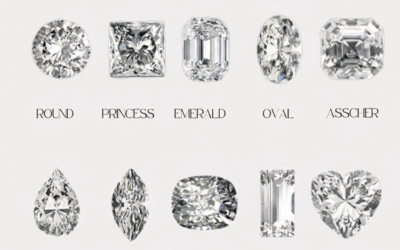
Picking an engagement ring is one of the most exciting (and nerve-wracking) decisions you'll ever make. With so many dazzling options, where do you...
Buying a diamond is a significant investment, especially in Melbourne, where the jewellery market offers everything from rare, certified stones to...