
ASET vs Ideal-Scope: Which Tool Is Better?
If you're spending five figures on a diamond, you want to know it'll actually sparkle. Not just look good on paper with a GIA certificate, but...
Armadale (03) 7019 8100
Brighton (03) 9593 2197
Canterbury (03) 9830 5600

Make an Appointment
Brighton (03) 9593 2197 | Canterbury (03) 9830 5600

If you’ve ever heard that an engagement ring should cost two months’ salary, here’s something worth knowing before you set a budget: that “rule” isn’t a tradition. It’s a line from a 1947 De Beers advertising campaign, and it worked so well that generations of couples have treated it as gospel ever since.
That’s the trouble with most engagement ring etiquette advice: some of it goes back centuries, while some was invented by an ad agency within living memory, and the two rarely come labelled.
At Holloway Diamonds, we’ve spent 50 years mastering the science of sparkle, and helping Melbourne couples separate tradition from marketing myth is a big part of what we do every day. In that time, we’ve sat with thousands of couples across every stage of this decision, and if there’s one thing five decades in the showroom has taught us, it’s that there is no single “correct” proposal, budget, shopping process or ring style. The right approach is simply the one that suits the couple in front of us.
This guide walks through where the rules truly come from, which of today’s “rules” are worth keeping, and which ones you’re free to leave behind entirely.
Explore the full range of engagement rings at one of our jewellery stores across Melbourne.

Long before any modern engagement ring etiquette existed, the custom of exchanging rings as a symbol of commitment already had deep roots. Ancient Romans are widely credited with popularising the practice, believing a vein, the vena amoris, ran directly from the fourth finger of the left hand to the heart, which is why that finger became the traditional home for a ring symbolising love.
According to historical accounts, the formal Christian tradition of the engagement ring gained further weight in the 9th century, when Pope Nicholas I declared that a ring given by a man to a woman signified an intention to marry, cementing the custom across much of Europe.
For centuries after that, engagement rings varied enormously in style and weren’t always diamonds. Bands, gemstones, and family heirlooms were just as common as anything with a stone. Diamond specifically became the default centrepiece far more recently than most people assume, which brings us to one of the biggest myths still floating around today.
The vena amoris belief places the ring on the fourth finger of the left hand.
Pope Nicholas I declares a ring signifies an intention to marry.
De Beers launches “A Diamond is Forever”.
The advertised benchmark is pushed from one month’s salary to two.
of American brides received a diamond engagement ring in 1940
by 1990, after decades of advertising
historical basis for a “correct” amount to spend
In 1940, only around 10% of American brides received a diamond engagement ring. By 1990, that figure had climbed to roughly 80%, a shift driven almost entirely by De Beers’ “A Diamond is Forever” campaign, launched in 1947 by copywriter Frances Gerety. The campaign initially suggested spending around one month’s salary on a ring; by the 1980s, the benchmark had been pushed to two months, a figure with no historical or cultural basis whatsoever, purely the product of decades of advertising.
There’s no “correct” amount to spend on an engagement ring, and there never was.
What matters most is choosing a natural diamond that’s beautifully cut, properly certified, and truly within your means, not chasing a number an advertising agency invented to sell more diamonds.
This is one of the most common conversations we have in-store. Couples often arrive with a figure in their head that’s causing real stress, and it’s rarely a number that reflects what they can comfortably spend. Once we talk through what actually drives value in a diamond — cut, clarity, certification — the budget conversation tends to relax considerably.
We’ve helped people find beautiful rings at every price point, and the happiest outcomes have never once been about hitting a benchmark.
A handful of questions come up constantly in the lead-up to a proposal, and most of them have far more flexibility built in than people expect. We can say with confidence that for every “traditional” answer below, we’ve also seen a couple do the opposite and have it turn out perfectly.
Not anymore. While the classic image of a hidden ring and a surprise moment still holds appeal for plenty of couples, it’s increasingly common to shop together, or for one partner to choose a ring based on style preferences shared in advance, with only the timing of the actual proposal kept secret.
Whether a ring can be resized depends on the design and setting, and in some cases, resizing may be limited or not possible. This is something to consider when purchasing the ring, particularly if the exact ring size isn’t known. We suggest bringing in an existing ring to compare sizes. If this is not possible, consider a design that is able to be resized if necessary.
Not at all. Plenty of couples propose with a placeholder, a family heirloom, or simply a heartfelt conversation, choosing the actual ring together later. This has become one of the more common modern approaches, particularly for couples who value having equal input into this decision.
Milestone dates, holidays and anniversaries are popular choices, but there’s no etiquette requirement here either. Many of the most memorable proposals happen on an ordinary day, precisely because it wasn’t expected.
Much of the etiquette above was written with one specific arrangement in mind, and it simply doesn’t map cleanly onto every relationship today.
There’s rarely a clear “traditional” precedent to follow, which many find truly freeing rather than limiting. Either partner, or both, might propose, buy, or design a ring, and matching rings, non-matching rings, or a single ring shared as a symbol between the two of you are all entirely acceptable choices.
Particularly for those who’ve been married before or who are blending established households, older etiquette around asking parents’ permission or waiting for a “big” surprise moment often feels less relevant. A quieter, more considered approach, built around what best suits both people, tends to fit far better.
Commitment rings and promise rings have become a meaningful alternative, carrying much of the same symbolism without needing to follow wedding-specific etiquette.
Modern engagement ring etiquette has moved a long way from the old assumption that one partner buys a surprise ring without any input from the other.

Many couples visit a showroom well before any proposal, discussing style, budget and stone preferences openly. This removes the guesswork and means the ring is something both partners have chosen meaningfully together.
Traditional etiquette assumes a man would propose to a woman with a ring he’d selected and paid for alone. Today, engagements happen in every configuration.
Traditionally, asking a partner’s parents for permission was considered essential etiquette. Many couples still value this gesture, reframed today as asking for a blessing rather than seeking approval, while others skip it entirely without any breach of etiquette.
Close family and friends are usually told before the news goes public, though there’s no strict rule here beyond basic courtesy.
Engagement ring traditions vary widely by country, and it’s worth knowing the differences, particularly if your family background sits outside Western convention.
In Australia, the UK, the US and much of Western Europe, engagement rings are worn on the left hand’s fourth finger, following the ancient Roman vena amoris belief.
In countries including Germany, Russia, Poland, Norway and India, engagement and wedding rings are traditionally worn on the right hand instead, a custom with equally old and valid roots.
Many brides temporarily move their engagement ring to the right hand, so the wedding band can be placed on the left ring finger first, before returning the engagement ring to sit above it.
There’s no single “correct” answer across cultures, which is precisely why so much modern engagement ring etiquette comes down to personal or family preference. Melbourne’s multicultural mix means we see this play out in real time: couples blending family traditions from different backgrounds into something that’s their own, and there’s nothing “incorrect” about any version of that.
Once the proposal is behind you, a different set of practical questions tends to come up.

Most people do, stacked on the same finger, though plenty of couples choose to wear their engagement ring on a chain or reserve it for occasions if their lifestyle or work makes daily wear impractical.
We recommend removing rings for heavy manual work, swimming in chlorinated pools, or activities where a natural diamond could be knocked or a setting loosened. This isn’t etiquette so much as practical care for a piece you’ll want to wear for decades. At Holloway Diamonds, we offer a complimentary annual check and clean for every ring purchased, to ensure it stays in top condition.
This is one modern addition worth following. A natural diamond is a significant investment, and having it valued and insured properly protects it in a way older etiquette never had to consider.
However you feel about the older rules, choosing a setting that suits your partner’s style matters more than following any single tradition.

The classic single-stone setting remains the most timeless option, echoing centuries of tradition with a beautifully cut natural diamond as the sole focus.
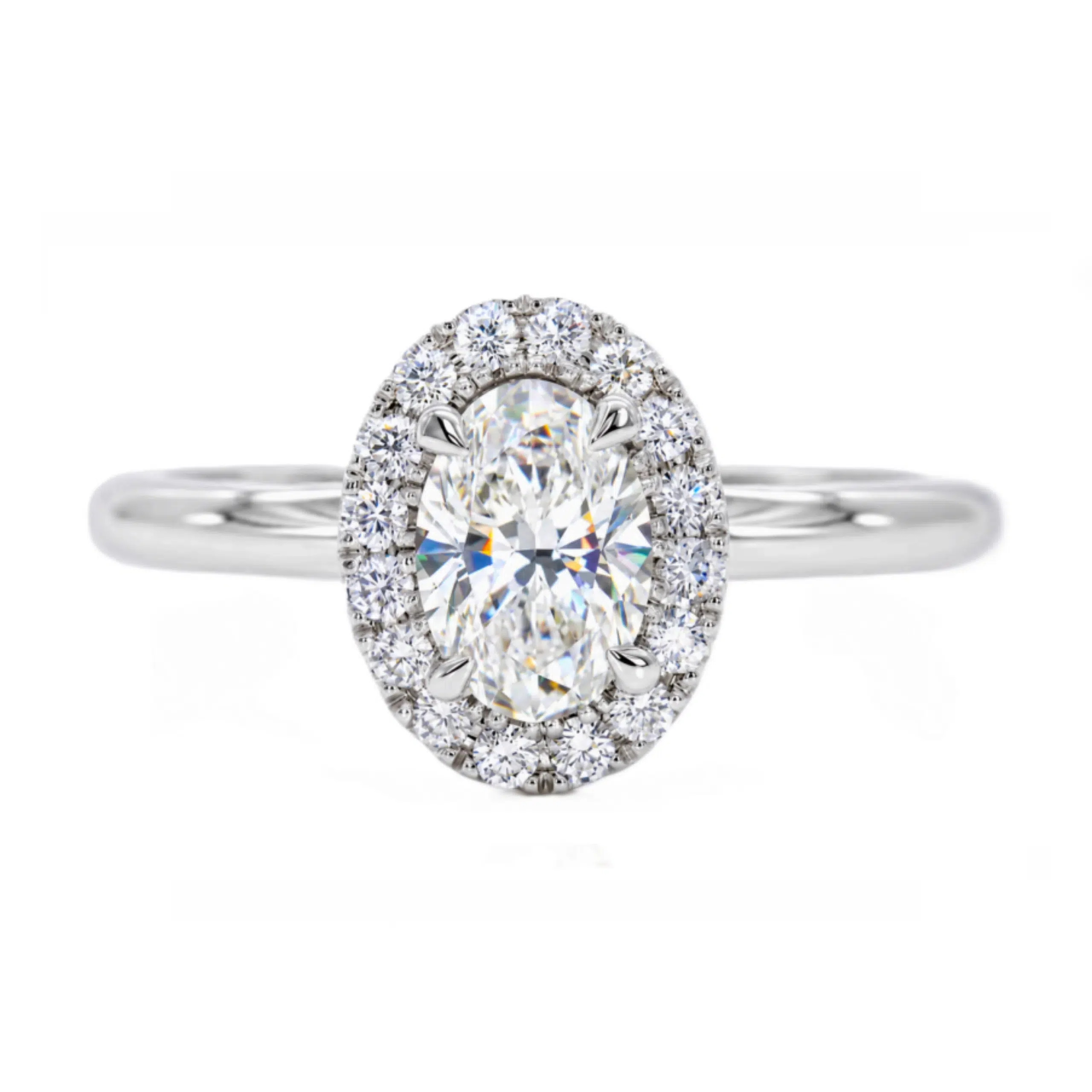
Surrounds the centre stone with smaller diamonds for extra brilliance, a popular modern take that still feels timeless.

Design a piece from scratch, whether that means reworking a family stone, choosing an unconventional shape, or building something that doesn’t reference any existing style at all.
Whatever traditions matter to you and your partner, and whichever ones you’re happy to leave behind, our team can help you find or design a piece that reflects your relationship rather than a rulebook.
Or browse engagement rings that our Melbourne CBD clients love.
And perhaps the most important thing we can tell you after 50 years of doing this: none of the above are rules in the way they’re often presented. They’re starting points. The couples who leave our showroom happiest are almost always the ones who’ve given themselves permission to do this their own way.
No. It originated as a De Beers advertising slogan in the mid-20th century and has no genuine historical or cultural basis. There’s no “correct” amount to spend on an engagement ring.
In Australia and most Western countries, engagement rings are traditionally worn on the left hand’s fourth finger. Several other cultures, including parts of Europe, traditionally wear them on the right hand.
Yes, and it’s increasingly common. Shopping together removes the guesswork and ensures the ring reflects both partners’ tastes, rather than relying on one person’s assumptions.
No, this is optional. Some families value the gesture, often reframed today as asking for a blessing, while others consider it unnecessary. Neither approach is a breach of modern etiquette.
Absolutely. Traditional etiquette assumed one specific arrangement, but modern engagements happen in every configuration, including self-purchased rings and either partner proposing.
If you're spending five figures on a diamond, you want to know it'll actually sparkle. Not just look good on paper with a GIA certificate, but...
Side by side in a showroom cabinet, platinum and white gold can look almost identical, both bright, both silvery-white, both stunning behind a...

Every diamond on display in our showrooms started its journey roughly 150 to 200 kilometres beneath the Earth's crust, billions of years before any...